

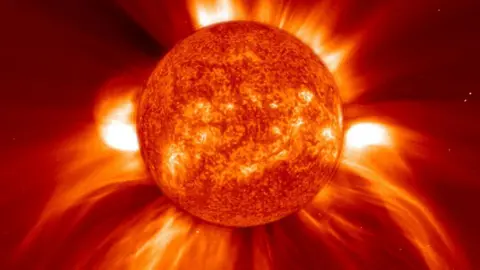
For Aditya-L1, 2026 will be truly unique.
This marks the initial occasion the observatory – which was placed into space recently – will be able to observe the Sun when it reaches its maximum activity cycle.
As per scientific data, it comes roughly once every 11 years as the Sun's magnetic poles flip – the Earth equivalent would be the planet's poles changing places.
It's a time marked by intense activity. It sees the Sun transition from peaceful to violent and features a significant rise in the number of solar eruptions and massive solar flares – enormous clouds of plasma that blow out of the Sun's outermost layer.
Composed of ionized particles, a coronal mass ejection may have a mass of billions of tons and can attain velocities exceeding 2,000 miles each second. It can head out toward various directions, even toward our planet. At maximum velocity, it would take an ejection about half a day to traverse the vast distance between Earth and the Sun.
"In the normal or quiet periods, the Sun launches two to three CMEs a day," says a leading scientist. "Next year, it's anticipated there will be 10 or more daily."
Researching coronal mass ejections ranks among the most important scientific objectives of India's maiden solar mission. Firstly, as these eruptions offer a chance to study the star at the centre of our planetary system, and two, because activities occurring on the solar surface endanger infrastructure on Earth and in space.

Effects on Earth and Orbital Systems
Coronal mass ejections rarely pose immediate danger to people, but they do affect our planet by causing magnetic disturbances affecting conditions in near space, where about thousands of spacecraft, comprising Indian satellites, orbit.
"The most spectacular manifestations of a CME are auroras, being direct evidence that charged particles from our star are travelling toward our planet," the expert clarifies.
"But they can also make all the electronics aboard spacecraft fail, disable electrical networks and disrupt meteorological and telecom spacecraft."
Historical Solar Incidents
- The most powerful solar event in history occurred during the Carrington Event that disabled communication systems across the globe
- During 1989, sections of Canadian electrical network failed, affecting six million people in darkness for nine hours
- During late 2015, solar storms disturbed flight operations, leading to disruption in Sweden and various European air hubs
- Recently in 2022, an ejection had led to dozens of spacecraft failing
If we are able to see what happens on the Sun's corona and detect a solar storm or a coronal mass ejection in real time, record its temperature at the source and watch its path, it can work as a forewarning to switch off electrical systems and satellites and move them to safety.
The Mission's Special Capability
While other solar missions observing our star, India's spacecraft holds an edge compared to rivals when it comes to studying the solar atmosphere.
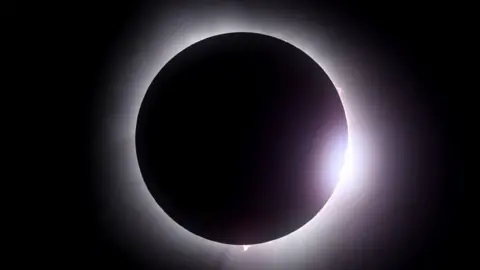
"The instrument is the exact size that lets it effectively simulate lunar coverage, fully covering the Sun's photosphere permitting continuous observation of almost all solar atmosphere 24 hours a day, 365 days a year, including during eclipses and occultations," says the researcher.
In other words, the coronagraph acts like a synthetic eclipse, blocking the solar glare to let scientists continuously observe the dim solar atmosphere – a feat the real Moon does only during specific moments.
Moreover, it's unique capable of examining eruptions in visible light, letting it measure a CME's temperature and thermal output – key clues indicating how strong of an eruption when traveling our direction.
Preparation for Peak Period
In preparation for the upcoming peak solar activity period, scientists collaborated analyzing information obtained from a major solar eruption recorded by the mission has observed recently.
This event began in September 2024 at 00:30 GMT. The eruption's weight was 270 million tonnes – the iceberg that sank Titanic weighed much less.
Initially, its temperature was 1.8 million degrees Celsius with energy equivalent comparable to millions of tons of TNT – relative to the atomic bombs on Hiroshima and Nagasaki were much smaller in scale each.
Even though the numbers make it sound massive, the expert describes it as a "medium-sized" one.
The space rock which wiped out the dinosaurs on our planet was 100 million megatons and when solar peak occurs, there may be eruptions with energy content equal to greater levels.
"I consider this eruption we analyzed happened during periods of typical solar activity. This establishes the benchmark that we'll be using to evaluate what is in store during solar maximum arrives," he says.
"The learnings gained will help us work out the countermeasures to be adopted to protect spacecraft in near space. They will also help achieving deeper knowledge of near-Earth space," he concludes.


